Divinity never Died.

Last Easter season was rough- and that is an understatement. *applause*

It was the first lockdown(going into 3rd lockdown in Ontario) as well as the time when I felt the most unsettled. Things were falling apart for me. My certainties of the faith I was given were no longer thunder and lightening, but a stilling breeze being stifled by a hot and humid summer.

I had so much to learn, so much to unlearn, and very little tools to properly process things, so emotionally, I was on high alert 100% of the time. It was also hard to find anyone who can relate and then not judge me or dismiss me for my questions or concerns. I would test the waters with a general observation and often get pushback for even stating said observation.

Evangelicalism is wired-obviously- but for a denomination that values truth, I found myself having to forgo authenticity for safety’s sake, and I think that’s saying something. As long as you agree verbally, and nod when you’re supposed to nod, then somehow you’re in good standing. And though I was told that “God looks at the heart,” I was able to find very few people who allowed me to bear my heart without condemning, giving ultimatums, or reacting in outrage. My heart that was hungry for truth and broken by weaponized scripture, I could no longer hide it, but why did I even have to?

This Easter season I found a little easier. I was able to listen and sing along to some worship songs and even listen to sermons regarding resurrection. I wanted to find a way of reframing it for myself. I’ve done this before with a few other concepts where I was able to demystify the literal and magical religious and parse out something a bit more tangible and often, even more profound.

During holy week, I listened to a few podcasts of “The Bible for Normal People” (highly recommend) and I watched an interview that Bruxy Cavey did a few years ago about the resurrection-and so. much. clicked.

This is what I came up with:

Jesus may not have gone down to hell, fought a literal Devil, got the literal
keys to death and hell in a glorious battle of ancient mystical beasts
Marvel-style, but the teachings of a man we call Jesus remain.

“…whoever believes in him shall not perish but have eternal life.” John 3:16

Believes: puts their trust in the truth of the words of this man Jesus
Have eternal life: a life of value, a life that lives on through the works of kindness, inclusion, and love

The promise of eternal life is not for some distant future time of glory and exaltation in a different dimension, with angels and cherubs at our beck and call, pouring endless wine, us munching on grapes, seeing the reflection of our mansion in the streets of gold. I mean, maybe it is, but maybe, just maybe the eternal life we’re promised for following the teachings of Jesus is a life of forgiveness, fulfillment, joy, service- a life of ultimate- read: eternal– value.

Dr. King’s life is one of those. His words and work are living on through the ages. His passion is still felt though his heart no longer beats.

A life lived not in self-indulgence that our privilege gives us, but instead using that privilege to share it with those less fortunate. Using our titles to exalt the lowly. Using our funds to support the destitute. Using our power to free the oppressed.

The divine isn’t risen because the divine never died. It lives on in this continuous thread being woven in history through people who call out injustice, challenge religion, fight oppression, and work to bring peace to earth and goodwill towards all humankind.

Jesus may or may not have risen from the dead in bodily form, in fact, a miraculous birth/conception and death/resurrection story was a very common embellishment for hero-turned-legend-turned deity (likely what happened with the story of this revolutionary Jewish Rabbi who was crucified by the state at the behest of the religious elite, and, as common for criminal executions, most likely tossed into a mass grave.)

But the teachings live on and so does the hope.

Every time we welcome the stranger, protect the sex worker, affirm the LGBTQ+ person, provide resources for the widow and the fatherless, support legislation for universal health care, reject consumerism and capitalism which exploits, protect the planet, etc., we are proclaiming life. We are, in a tangible and real way, giving a second chance for life, improving life, or even saving life from a premature death (LGBTQ+ youth has a higher suicide rate in non-affirming spaces).

The divine never died but rises through each of us who choose to join in eternally valuable work that will benefit generations to come.

And to that I can say: risen indeed.

Witch hunt

Thinking through the awful event that happened in Atlanta and the 8 lives that were lost, it hit me. I had heard this thought before, and it is only now that I see it plain as day. The theology of original sin and atonement theory are toxic in and of themselves. How?

The literal groundwork for the Gospel is that all of mankind became cursed because of a woman.

This is the source and justification for misogyny, objectification, and the sexualization of women-they sinned first. Women brought doom on all of us. Women can’t be trusted. Women fail by nature.

I remember being so mad at Eve when I was a little girl. I used to plan things I’d say to her when I get to heaven-if she’d even be there- I’d scoff. I’d tell her thanks(sarcastically) for earning us girls a period and ask her if it was normal for snakes to talk and why she’d fall for it.

The irony.

Misogyny isn’t always explicit. In fact, I’d argue that it’s most potent in small doses. It builds up story after misinterpreted Bible story, sermon after sermon, excused “boy behavior” after punished “girl behavior.” It’s generations of bread winners and homemakers. Generations of pastors and pastors wives. Generations of fearless leaders and strong, but silent, support at home.

Women are the heroes for “looking out for their brothers” through modest dress, for enduring abuse by staying in a toxic marriage “for the sake of the children”, for teaching children quietly at home, for “allowing” their husbands time to pursue dreams, hobbies, and ministry. And if women don’t sacrifice their existence for the pleasure and progeny of men? Well, then they’re villains-never victims.

You see, it was women who sinned first, therefore, they need male supervision, direction, approval, and control.

They cannot be victims because they sinned first, they must have done something to provoke because women started it.
The husband hit her? Well, are you sure she wasn’t acting out of line?
She got yelled at and belittled by her man? She was probably being too emotional or loud, God forbid she talked back.
She was cheated on? Surely she wasn’t putting out then. Doesn’t she know that it’s ok to have sex after 6 weeks pp?

Assumptions, conclusions, ‘harmless’ jokes about the kitchen, preachers normalizing a “divorce weight”, telling women teachers to “go home”, and here we are. 8 women murdered, 6 of whom are Asian American.

We are living in a world in which, for the last 4 years, a racist misogynist was embraced by 81% of people who believe the creation myth of an ancient people-that there were only two original humans, and that the female brought on the curse because a talking snake told her to eat some fruit. This 81% votes, serves in leadership and in elected positions, contributes to popular media and thus perpetuates the perceived reality of this myth, causing great harm.

I’d like to say I’m not surprised, but at this point, I actually have no words.

My heart grieves with the Asian American community. My heart mourns all lives of women that were taken by violent men who’s god is their own image.

We might be living post-enlightenment, but the church seems to be very happy to remain in the dark ages as that is where it is justified to keep burning witches.

Where did we all go wrong?

The language of expectations within Evangelicalism inspired me to think through these things, though I’m no longer sure how this all ties in to the language of expectations, bear with me.

Also, these are raw thoughts meeting the keyboard for the first time. I might rethink all this one day, I might even disagree, but I want this to be out there as a monument of sorts to where I am in my journey.

I’ve been thinking about unconditional love lately. That god is love. That we’re loved unconditionally. Loved. That’s it. 

FULL STOP.

No expectations, no exceptions, no prerequisites…except then we sit under toxic preaching and hear “God loves you so much, he HAD to kill his son.” I’m sorry, WHAT?? I can’t imagine harming someone to prove my love to my husband. What kind of maniac would require such a thing? 

And that got me thinking that the maniac is the one who painted god in that light- who created god in their own hateful, murderous image, and then wrote it down in a holy book.

Jesus reserved harsh words of judgement for the religious who placed impossible burdens on others, who presented god as a hateful, wrathful, and as an abusive god when something doesn’t go his way (Of course god is male). Jesus said that if anyone causes a believer in the way and teaching of Jesus to stumble-if anyone poisons the image of god that is revealed through the self-sacrificial, all encompassing acceptance and love of Jesus, “it would be better for them if a large millstone were hung around their neck and they were thrown into the sea.” (Mark 9)

Full stop. Literally.

And then I think about the sacrifice part.. Jesus willingly turning himself in to be killed by a mob could be showing us a peaceful resistance to violence instead of a pagan-esque blood sacrifice. At that time, humanity believed that the Supernatural wants blood and death, humanity understood their image of god to be as barbaric as them, thus justifying their violence and thirst for blood as something holy or divinely inspired.

We see it in Abram, willing to kill his only, long-awaited son to start a new religion, because that’s what ya did back then. We go to the notary to sign our life savings away, they went to the altar to give up their most valuable(often times children) in hopes of a heard prayer and blessed outcome. Abram and his audience weren’t yet ready to understand that blood does not need to be shed, they could not grasp the concept of a non-retributive justice to being wrong or being wronged, so they settled on an animal in lieu of a human. “God” provided the lamb.

I find it odd that we’re told that god loves us and forgives us…but he has to kill his son to do that. Manipulative, no? In a court of law, if you’re acquitted, does anyone have to serve time? No. Acquitted. Done. No goats, no blood, no sons. Go in peace and crime no more.

Divinity aside, when Jesus willingly goes to the mob, and calmly takes the taunts and abuse, I imagine the people watching were quite stumped- why isn’t he fighting back?! Why isn’t he pleading innocence?! Even Pilate throws him a lifeline, but Jesus’ silent resistance says: enough is enough. I will conquer your violent desire for death by dying at your hands. You wanted me to be king, to usurp power and control, I’ll instead die in shame to put you to shame for how much you love violence. Jesus is teaching us that god didn’t give his son to be slaughtered because there’s some transaction going on in heaven and it just needs a few drops of blood and a death, like the good old days. Jesus is teaching us that god doesn’t want death and violence as a sign of faith and loyalty because god him/herself doesn’t work that way, never did. In the most dramatic display of what love does, Jesus lays his life down willingly-not to appease a tyrant, but to forever change humanity’s ideas about the divine: god is love.

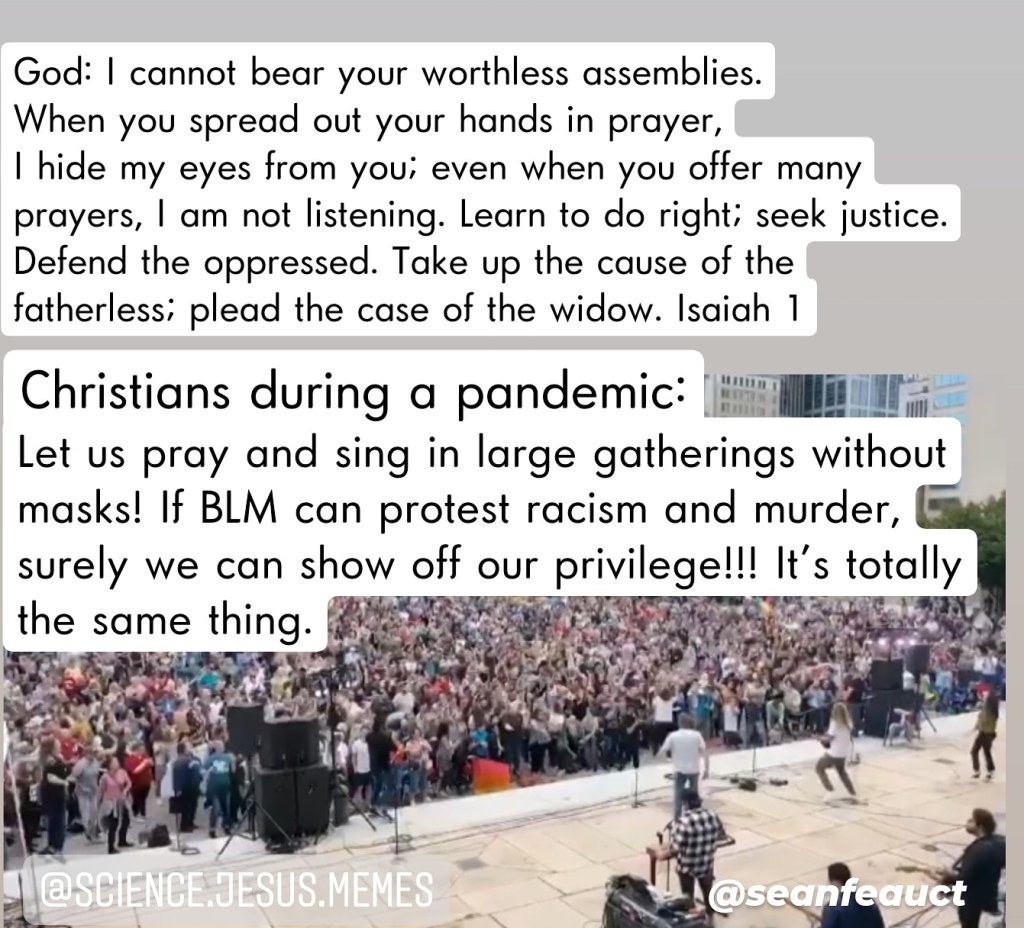
In the book of Isaiah, Isaiah(the OG “progressive snowflake”) tells the people that god does not want their useless sacrifices, he can’t stand their religious assemblies. He tells them: “Learn to do right; seek justice. Defend the oppressed. Take up the cause of the fatherless; plead the case of the widow.” (Isa 1:17) is that not a direct command to take god to task on matters of social justice? Read the first chapter of Isaiah post-deconstruction. I dare you. 

Isaiah opens up by saying that the people had left god, yet we see that they continued with worship assemblies, prayer meetings, and bringing their sacrifices. God makes his/her feelings about sacrifices very clear: ““The multitude of your sacrifices— what are they to me?…I have no pleasure in the blood of bulls and lambs and goats.  When you come to appear before me, who has asked this of you, this trampling of my courts?”…”Come now, let us settle the matter,” says the Lord. “Though your sins are like scarlet, they shall be as white as snow; though they are red as crimson, they shall be like wool. If you are willing and obedient, you will eat the good things of the land..”” (Isa 1:18) God condemns their sacrifices that they brought for forgiveness of sins, and then offers forgiveness if they change their behavior. No lambs. No sons. Just take up the case of the fatherless and the widow.

I’m no theologian, obviously, but something tells me that god doesn’t operate in a manipulative and abusive “I killed my son for you” kind of way. And if he does- woe. It’s kind of like giving a gift. If you give a gift and then receive a gift for giving a gift, is it really a gift or a mere transaction? When my son asks for forgiveness, I readily forgive and only ask for changed behaviour, knowing full-well that the scenario will happen a dozen times everyday. Heck, I even forgive when he doesn’t ask, because I LOVE HIM. If a mere human is capable of such love, how much more is the divine?

Remember Judas? Jesus knew that Judas would betray him, yet, Jesus did something so beneath a rabbi, what only slaves were allowed to do- on the night of the betrayal, Jesus washed Judas’s feet. Love. Unconditional love.

My fundamentalist faith preached the love and acceptance of Jesus, but there were always expectations to meet, there were conditions which needed unanimous agreement. Now, talking to friends and family, I can sense their disappointment that I no longer live up to the expectations they had for me. This box they created, which I was supposed to fill, was just too small to encompass what I had become to know as reality. Considering that I’ve always done my best to adhere to group think and uphold the status quo, I now realize that I never truly got to be myself around the people I loved and valued most. They never got to know the real me, and the old me whom they loved had never existed.

“These aren’t your thoughts,” “your account got hacked,” “It’s disappointing to see this from you,” “You were so fervent and passionate in your faith.” While I understand the fear and pain behind such statements, they still hurt because in the evangelical world, they usually mean that now you’re a project to be prayed for and won back. “And of course we love you, that’s why we’re being abusive, manipulative and condescending to save your soul. Hell’s worse, buttercup.”

On the other hand, loving these people for who I perceive them to be is also proving very difficult, especially loving them like Jesus. And then I remember that Jesus wasn’t buddy-buddy with the religious, he didn’t hang out at the temple 5 days a week, with a select group of supremacists. His people-his church- were all outside of the temple courts, far away from the holy of holies, and that is where I hope you’ll find me.

Does not Spark Joy

I recently learned about Nichole Nordeman’s music. She has deconstructed and put out some really inspiring and thoughtful work. I went to church this Sunday, and though, coincidentally, the sermon was about doubt, it felt dismissive, manipulative, and restricting.

Paraphrase and gross over-simplification of a snippet of the sermon: genuine questions are ok, but if you refuse the answers given, if you heard the message, attended church, but refuse to “bend the knee of your heart to the King,” you have “the worst that hell has to offer awaiting you.” Nice. Ask questions, accept our answers. You can’t? You must be refusing. Hell it is.

Though my husband will argue that we heard 2 different sermons, as someone who is IN the pits of deconstruction and doubts, this sermon did not *spark joy* and I did my best to stifle any and all criticism and cynicism while listening. Honestly, I do not expect joy to be sparked from a sermon on doubt, but hope in the midst of confusion, understanding of the deeply unsettling, incontrollable nature of doubt, and no threat of hell to force you into a quick decision seems like a kinder, more effective and less isolating approach.

Today I listened to some of Nichole’s songs, and they gave me fresh hope and validation.

This quote, Nichole’s reflection on her journey, really struck me: “When you’ve already survived something, you say nice things about it, but when you’re in the middle of surviving something, you say real things about it.”

It wasn’t until I started being completely honest with my thoughts and feelings that I began to feel the most free, most genuine, and most alive than I’ve ever felt before.

Those thoughts and feelings weren’t always happy, comfortable to admit, or even close to what I was taught as “correct”, but someone once said “the truth will set you free,” so I allowed myself to be honest. As brutally and painfully honest as I could be.

Instead of suppressing questions and doubts out of fear, dismissing them as “thoughts from the enemy”, or bypassing them with toxic positivity(“give it to God, let go and let God, God will make a way”) I faced them head-on.

I said scary and sacrilegious things out loud– not because I’m a rebel saying things to be “cool” or asking for attention, but because they were my actual thoughts, my genuine questions. David writes “I cried unto the Lord with MY voice,” and so did I, with my whole voice of my whole being because the Divine isn’t scared of my questions, intimidated by my inquiries, or offended by my confusion and pain, “…a broken and contrite heart you, God, will not despise.” (Psalm 51:17)

I embraced my doubts and scary thoughts. 

I sat with them.

I felt them.

I cried through them.

I shook and still shake with rage because of what they have revealed.

I wrestled. 

I am still wrestling– and though I may come out of this wrestling match with what others might see as a limp, that limp is part of who I am. It is part of my whole self, my unapologetically honest self because I am not Jacob the trickster, I am Israel: the one who wrestles with God. Why would I ever want to be anywhere else? Why would I want to hide that from the world? I’m limping, but I LIVE. (reference to when Jacob wrestled with God and was given his true name)

I am officially sobbing as I come to this realization-like right now as I write this- tears, so many tears. I am not an “apostate, a heretic” who is deceiving, sowing dissension, and leading others into temptation. I am a human wanting to know not from a forbidden tree in a lush garden, but from the voice that is calling in the wilderness– calling those in the valley of dry bones to real, honest, abundant life.

Some days I wake up and wish I could be done with this. Wish my head would stop thinking and I could be “normal” and not deal with deconstruction. Not be triggered by, well, literally everything. It feels like too much sometimes and I want to say to the Divine, “pick on someone your own size!” Until I remember that I am made in the image of God- in the image of one who embodies wisdom, creativity, freedom, truth, and life.

And it is then that I am ok with my limp, my name, and my wrestling.

Tourists. Damn Tourists.

9/11 hit a little differently this year. I thought about it all day yesterday and when today came, my mind was a complete mess, which got even hazier as the day wore on.

I’m not entirely sure what made it so different. It could be the already horrible weight of the global pandemic.
It could be the reminder that 9/11 is a childhood friend’s birthday with whom I cut ties recently because of my support for BLM.
It could be because deconstructing religion has made me more aware that most of the awful evils ever done were done in the name of a god by indoctrinated people across all beliefs.
It could be because I never fully grasped thus never fully grieved the loss and terror of that day, as I was a child when it happened.

Sad to admit, but I too, believed in part some of the conspiracies going around about 9/11. My embarrassment at this fact, coupled with disgust and horror that those theories are still alive and well, could also be a reason for why this year it all hits a little harder.

My 10 year old self was in school that day, and we were excitedly preparing for the annual open house when our parents would meet our teachers and mingle. I vividly remember catching a glimpse of another teacher’s TV as my class walked past his classroom. That’s when I saw that surreal image of the towers up in smoke. Settled in at my desk, much to my dismay, we were informed that the open house is cancelled. The rest of the day was chaos and confusion. We mainly sat around until dismissal while the teachers whispered in the hallways. I don’t remember if my teacher had said anything as to what is actually going on, but it was clear that something very serious has happened.

When I got home, my mom ran out of our apartment to collect me from the bus stop which was maybe 30 meters from our front door. She ran towards me and with fear and trembling in her voice said: “Terrorists! Get inside! Terrorists!” I did not know what terrorists were. I actually thought that she said “tourists,” so I imagined a throng of overweight white people, in wide brimmed hats and Hawaiian shirts, getting off of a tour bus and walking like zombies. Oh to be 10 again—reality was not so kind and well-humored.

As someone who is just now coming to grips with the reality of that fateful September day, I’ve not much useful insight to add, but through all of this, I’ve again learned that life can be unrelentingly cruel sometimes. Most of the time as of late, thanks  2020. Today I am also reminded of just how short and volatile life is. How precious and rare are moments of comfort and calm. How important it is to love people, to be kind, and to consistently check our beliefs to make sure that they are not hindering our ability to show love and compassion towards others.

In Christianity specifically, the second most important commandment uttered by Jesus is: “love your neighbor as yourself”. Who is my neighbor? Using a parable, Jesus beautifully illustrates that one’s neighbor is the one others would consider an outsider. It is the one who is hurting, the one who is in need, the one who may cost you some of your own resources. Our neighbors are those who the church has cast out and distanced themselves from, deeming them “unclean”. Loving our neighbor can look like inter-faith friendships, diverse community, social programs/assistance, giving a voice to the voiceless, making room at the table for the marginalized, using our privilege and platform to benefit those who could be drowned out by us instead.

As I write this, it’s all coming together.

THIS is the true gospel that I’ve been deconstructing towards. It’s not interpretations and hermeneutics, not even the trinity or atonement, *gasp*.

It is loving our neighbor enough to give them a chance at enjoying and living a full and beautiful life, because life is precious, but damn, it. Is. Fleeting.

Ain’t it.

I started a little memes page on Instagram. I had no clear idea of where I’m going with it, but I knew that I wanted to explore and poke at the fallacious teachings of young earth creationism and other anti-science teachings in the church. As days went on, and my faith started crumbling, I found myself sharing more than memes. I shared my soul with complete strangers on the internet.

They loved it. They related. They felt safe and heard through my experiences.

I’m still blown away by the 2.7K followers who came for the laughs and stayed for the deconstruction of religion. It’s beautiful to connect with so many people who can confirm that I am indeed not crazy, and my feelings regarding my experience and religious upbringing are valid.

However, I recently got a message that my account ain’t it. That I’m attacking the church and throwing everything away. Listen-listen. I respect the opinion if it’s how someone feels, and to be clear: as I deconstruct, I realize that it is messy, and I’m thankful for those who are giving me the space to feel and reflect, while understanding that I’m coming from a place of discovery, and not dogma.

Discovery over dogma.

There are days when I feel cheekier(i.e. pissed off) than others, so I say something. In those days, I see empty words promising invisible prayers for a problem that requires tangible actions from people who claim they know the most powerful being. This being, they say, has equipped his children with the tools and resources to fix a lot of these problems, but instead they silently and motionlessly pray all the while hoarding those tools and resources, claiming them as personal blessings for being so darned cute.

There are days where abuse is called “a cross to bear”, leaving the victim powerless. There are days when I see people unable to speak up because their whole life depends on being quiet and compliant. There are days where I see people suffering in guilt and shame because the stifling beliefs which they were wrongly given do not allow them to trust their emotions, set up boundaries, or call out abuse.

They are to:
“turn the other cheek,”
endure outright injustice because “our present sufferings are not worth comparing with the glory that will be revealed in us,”
remember that “all things work together for good to them that love God, to them who are the called according to his purpose,”
and when it gets really hard, remember that you “can do all things through Christ who strengthens” you.
Besides, God will never give you more than you can handle. (My favorite out of context verse)

There are far too many of these days.

If I’m not calling out toxic theology, where verses are taken out of context and broadly applied to anything that is mildly inconvenient for the church to deal with, or something that could make the church look bad while real people are being hurt, who am I protecting if not the abusers of power?

If a teaching, a belief, or an idea is hurting people and traumatizing them, how dare we tell them to pray a prayer and Jesus will fix everything. *magic* If he doesn’t, he’ll teach you how to live with it. If you’re still not content? It’s a heart issue, sis. YOU’RE doing it wrong.

No. no, no, and NO.

For as long as dogmatic interpretations of an ambiguous ancient text are creating space for abuse, trauma, brokenness and hurt by people who claim to worship and follow the One who accepts, heals, loves, and restores, I will continue to call it out for what it is. I will continue to bring attention to the ugly hatred of those who sing praises to the God of love.  Their salt is toxic. Their light only brings heat. They are using God’s name in vain to maintain power which hurt others all the while condemning those who merely say “OMG”. They are the wolves in sheep’s clothing raising their hands in praise, taking communion, never following the Way, the Truth, and the Light, only believing and worshiping.

Those of us who are leaving, bringing issues to light, or asking uncomfortable questions, we’re not trying to cause new problems. We want the existing ones acknowledged and fixed.

What we have right now- a church defined by national pride, white supremacy, and toxic theology- ain’t it.

It ain’t it fam.

It ain’t it.