art
I Done Goofed

Hey friend. I hope you’re well.
I’m currently sitting by the window in my room, listening to my son playing in the next room, singing his ABC’s “C B C D E F G H M M M O P”. It’s a snowy day here in the GTA, and I don’t mind it one bit.
I wanted to share a follow-up on my Van Gogh post. It’s kind of funny, to me at least.
After spending an emotional evening Googling Van Gogh’s life, I wrote and published the piece, sharing it on a few social media platforms. The response was lovely. People were moved and found the story resonating with them, especially Van Gogh’s struggle “I wish they would just take me as I am.”
One comment stood out above the rest though. For some unknown reasons, it’s now deleted, but I will paraphrase: “Interesting observation. My church usually turns the lights off at night, so if it was painted, it wouldn’t have light in its windows either.”
Light-bulb moment.
Are you guys with me?
I laughed and laughed when I read that comment. Like, DUH, the commentator isn’t wrong! Based on the position of the Moon and Venus(the brighter object to the bottom-left of the moon) we know that Van Gogh painted the piece in the early hours of the morning(at least that’s what the painting tells us, if he was painting what he saw). The lights technically would be off in public buildings, while residences are just beginning to wake up and start their day.
I was genuinely stumped after this comment because she’s not wrong. Was I just reading too much into the painting? Am I allowing it to affect some past hurts?
And that’s the beauty of art.
For some, it can have a profound impact and really resonate with their journey. They can relate to the artist’s struggle of trying his best for his God, but still falling short in the eyes of rich and powerful men. While for others it’s about being economical and practical: turn off the lights when you’re the last one to leave the room. Neither interpretation is wrong, and I love that!
Knowing what we know of Van Gogh’s religious background and experiences, in addition to his artistic brilliance, I think it is safe to assume that the lack of light in the windows is a subtle hint at his feelings. In my previous post I mentioned that I could go on so many tangents, and one really could extrapolate many different meanings from studying the painting and artist.
Life is very much like that, isn’t it? There are so many things that are unclear, so many things that are far more gray than they are black and white. Being able to share these observations and becoming aware of other peoples experiences helps us understand and see the world for what it is, a brilliant spectrum of vivid colors revealed by a constantly shifting prism.

Here I am again, reading so much meaning into a simple online exchange.
Whatever your take-away from either of these stories, please do turn off the lights when you’re the last one to leave the room. I promise I won’t try to read too much into it.
Thanks for reading,
Love, Kris.
Van Gogh: This is not about his ear

I have to admit, I am no art connosseiur. I don’t even know how to spell connosseiur. (I won’t auto-correct just to prove my point, but why would you put the “i” after the “o” in the correct spelling- now that I’ve Googled it? French words are hard).
One does not need to be even remotely interested in art to have heard of Van Gogh, his ear incident, or- one of my now favorites- the Starry Night. I have always been mesmerized by the swirling pattern and the calming blue hues. As Neil deGrasse Tyson points out, it is the only painting named for its background and it’s an accurate representation of the night sky over where it was painted. However, there is one thing that I never noticed: the lights.
I was listening to an episode of Ask Science Mike recently, and he shared that Van Gogh was actually a preacher in his earlier years, which is a well-known fact I was not aware of (recall: not a connoisseur). More interesting than that, moved by the poverty of the mining town he was serving, Van Gogh gave away his middle-class belongings and showed up to preach many-a-times with hay in his hair or looking disgruntled because he slept on floors in a bid to live humbly. He wanted to embody his Christ, the man-of-sorrows.
And so he was fired by the church. Weren’t expecting that one, were you?
Apparently putting into practice the love and compassion of Jesus is not how to live out one’s faith. We can talk about Jesus, but that feeding the poor thing? Nope, not for us, lest we be too zealous. (I could go on so many tangents right now, but let’s focus. That’s mainly a note to self)
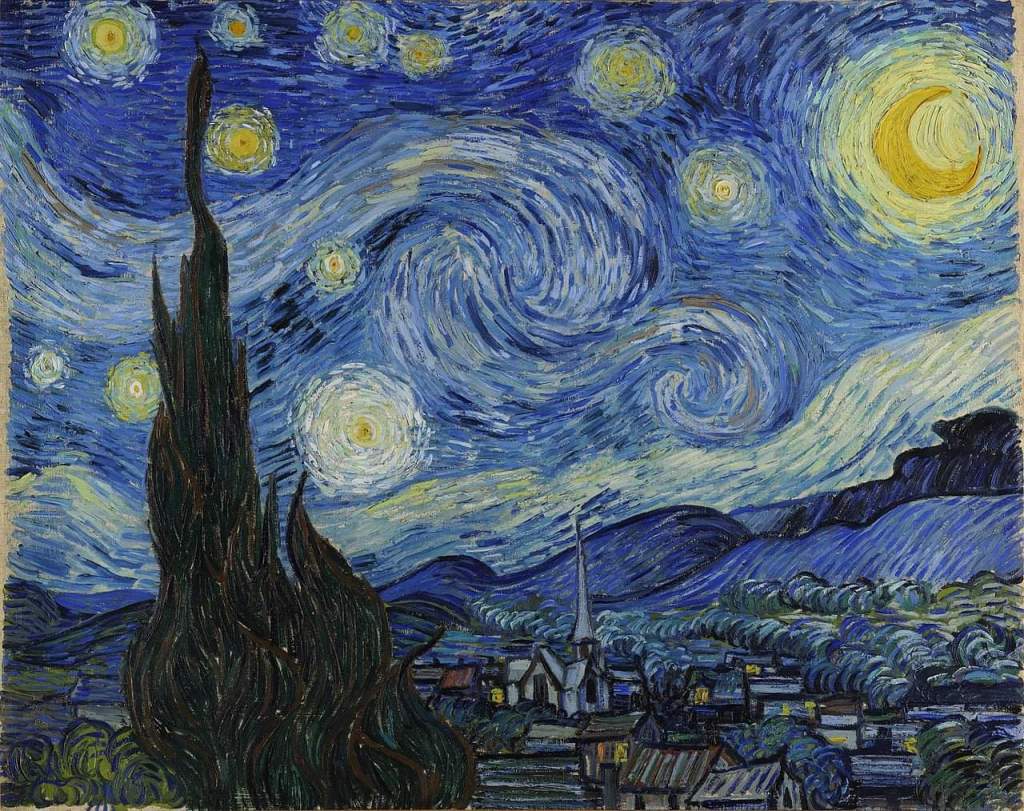
When you look at the Starry Night, pay attention to the windows of the buildings. Notice how there is a church in the middle? It has no lights in its windows. There is a light in the window of every single building but the church’s. The one place that claims to know the source of light stands tall, but dark.
Left embittered and impoverished by this place that also teaches love and acceptance, Van Gogh left the church, later writing in a letter to his brother Theo: “I wish they would only take me as I am.”
Please tell me I did not over-react by getting emotional when all of this came together for me?
Either way, I did get emotional. Here we have a young man completely devoted to his God, only to be told that he’s actually not supposed to act on his faith/convictions to benefit the less fortunate. In one account I heard that he gave away all of the money given him by the church to buy a house. That could explain why they didn’t like his fervor. I just find it so ironic though. And frustrating.
I imagine this young man, 27 at the time, feeling utterly powerless. Having done nothing inherently wrong, he was receiving two completely different messages from sources that are supposed to line up in their values. Scriptures: “feed the poor…blessed are the meek…the son of man had no place to lay his head…” The church: “hang out with better company…you are too zealous…here is a tremendous amount of money that can help a lot of people, buy yourself a house.”
I think it a splendid saying of Victor Hugo’s, ‘Religions pass away, but God remains.’
Van Gogh on God
The tall and dark church is a subtle, yet powerful image 120 years after its creation. Who would have though that simple brush strokes on a canvas and the absence of yellow could so accurately represent the state of the church today.
“I wish they would only take me as I am,” reminds me of the parable of the prodigal son. How, when the son returned to his father, it was the father who clothed him. It was the father who gave him his title. It was the father who hugged and kissed him. It was the father who ran to him while he was still a long way away.
I’m left wondering, how many people- like Van Gogh- has the church rejected, when the father would have not only embraced them, but given them a title and noble clothes? Are we even in that place to say who gets in and who doesn’t? (no, we are not)
By all the rules of the day, the father had every right to throw his son in jail for the disrespect and shame the son brought on the family. Yet- yet we see the father taking in his son, just as he is.
If he had never experienced this pain, maybe we’d never have Van Gogh’s Starry Night. Or maybe, we would have had Van Gogh a little longer.
His life took a lot of interesting turns, and it did end in rather tragic circumstances, but for me, the absence of yellow is the biggest lesson that I learned from Van Gogh’s Starry Night.
I want to be where that light is, even if it’s found in the most unlikely places.
-Kris
 Thought Fossils